Why Self-Distribution and Rights Ownership Are Essential for Independent Documentary Filmmakers
For a long time, distribution was something filmmakers chased. We finished a film, handed it off, and hoped it would find its way. A lot of times we noticed that the film or video ended being uploaded to YouTube where it struggled to get views. Soon it became almost forgotten. That approach doesn’t hold up the same way anymore, especially for independent documentaries built with partial funding and a lot of personal investment.
At WorkCabin Films, we approach documentary projects differently. When we film and produce an independent documentary—even with funding support—we do it with the understanding that we will retain the rights and take responsibility for how the film moves through the world. That’s not about control for the sake of it. It’s about making sure the film has a long life, and a real chance to recover costs.
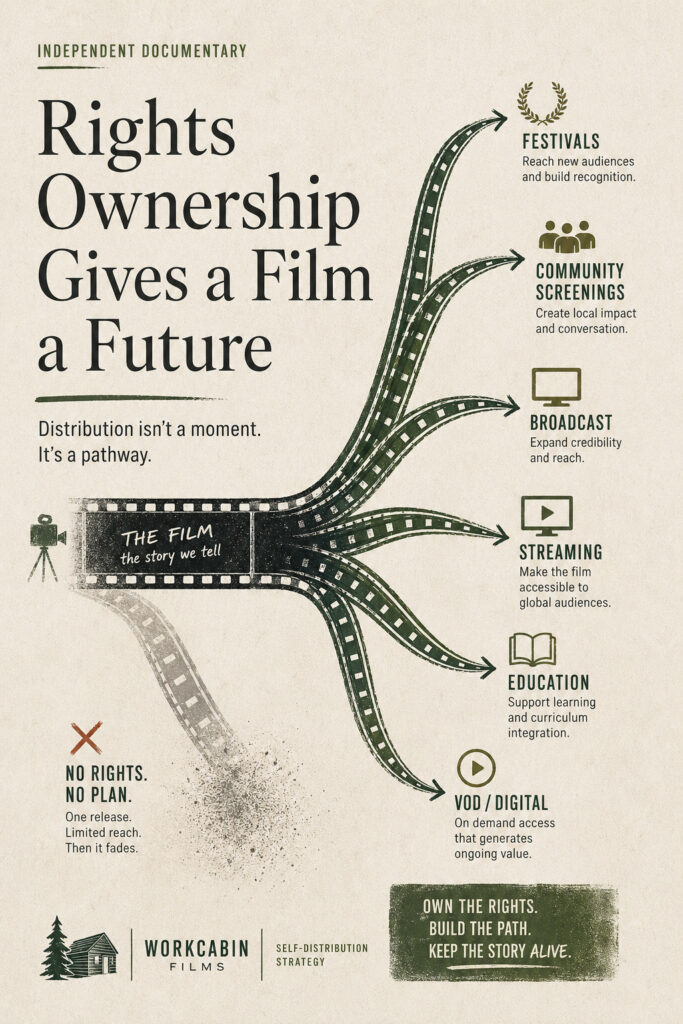 Cost recovery is part of the reality for our independent work. Funding typically does not account for all the hours of filming and post-production. We are investors in the film project too. A self-distribution strategy, grounded in the rights we retain, gives us multiple ways to work toward that over time, not all at once. It allows the film to keep generating value, both financially and in terms of impact.
A long life for the film means everyone shines brighter: The research featured in the film, the researchers, the message, featured organizations, funders, and WorkCabin Films.
Rights are what make that possible.
If distribution, viewing rights, or public sceenings are fragmented or signed away too early, the film’s path becomes fixed. A single release, a limited window, and then it fades. But when we hold onto them, we can build a distribution approach that evolves over time. We manage festival exposure, targeted community screenings, educational access, partnerships, broadcast opportunities, streaming, VOD (Video On Demand) and digital release, all working together rather than competing.
We’ve seen how this can open doors. One of our documentaries reached PBS after being seen at a recognized top-tier film festival. That opportunity didn’t replace everything else. It added to it. That is because we maintained flexibility, we could say yes without closing off other avenues.
Uploading a film and hoping it gets noticed isn’t a plan. Building a distribution pathway that reflects the film’s purpose is.
That’s the big shift. Remember: It’s not just making films. It’s also about making sure they can sustain themselves and continue reaching people long after release.

- Rattled: Back from the Field in Ontario - October 15, 2026
- Choosing Music for Conservation Films: More Than Just Background Sound - September 14, 2026
- We’re Looking for Conservation Partners - August 25, 2026